

Why is my dog so itchy?
Dr. P's way, in ten seconds
Three causes, from the easiest fix to the hardest
Allergies in dogs come from three places. This is the order I work through them in the exam room, and the order I'd work through them at home.
 1FleasEasiestFleas are the simplest to sort out. One bite can keep a flea-allergic dog itching for weeks, and strict flea prevention, all year round, usually does the trick.
 2FoodTakes 8 to 12 weeksFood allergy itches all year. Beef, dairy, chicken and wheat are the most common triggers in the studies, and I see chicken more than ever. The only way to know is an 8 to 12 week prescription diet trial.
 3EnvironmentLifelong managementEnvironmental allergies come from pollen, grass, dust mites and mold. They're often seasonal but can be year-round. There's no cure, so we control them with a step-up plan.
Plus: infections ride on top of all three
Allergic skin is easy pickings for bacteria (usually Staphylococcus pseudintermedius) and yeast (Malassezia). They pile on during a flare and make the itch a lot worse. Your vet treats them with antibiotics or antifungals, but they'll keep coming back as long as the allergy underneath isn't controlled.
Start here
What I'd do first, step by step
Before anything else, rule out fleas. Keep every dog and cat in the house on a vet-recommended flea preventive, every month of the year, even if you've never seen a flea. It's the easiest piece of the puzzle, and while fleas are still in the mix, nothing else on this page will look like it's working.
Is your dog's itch year-round, or does it come and go with the seasons?
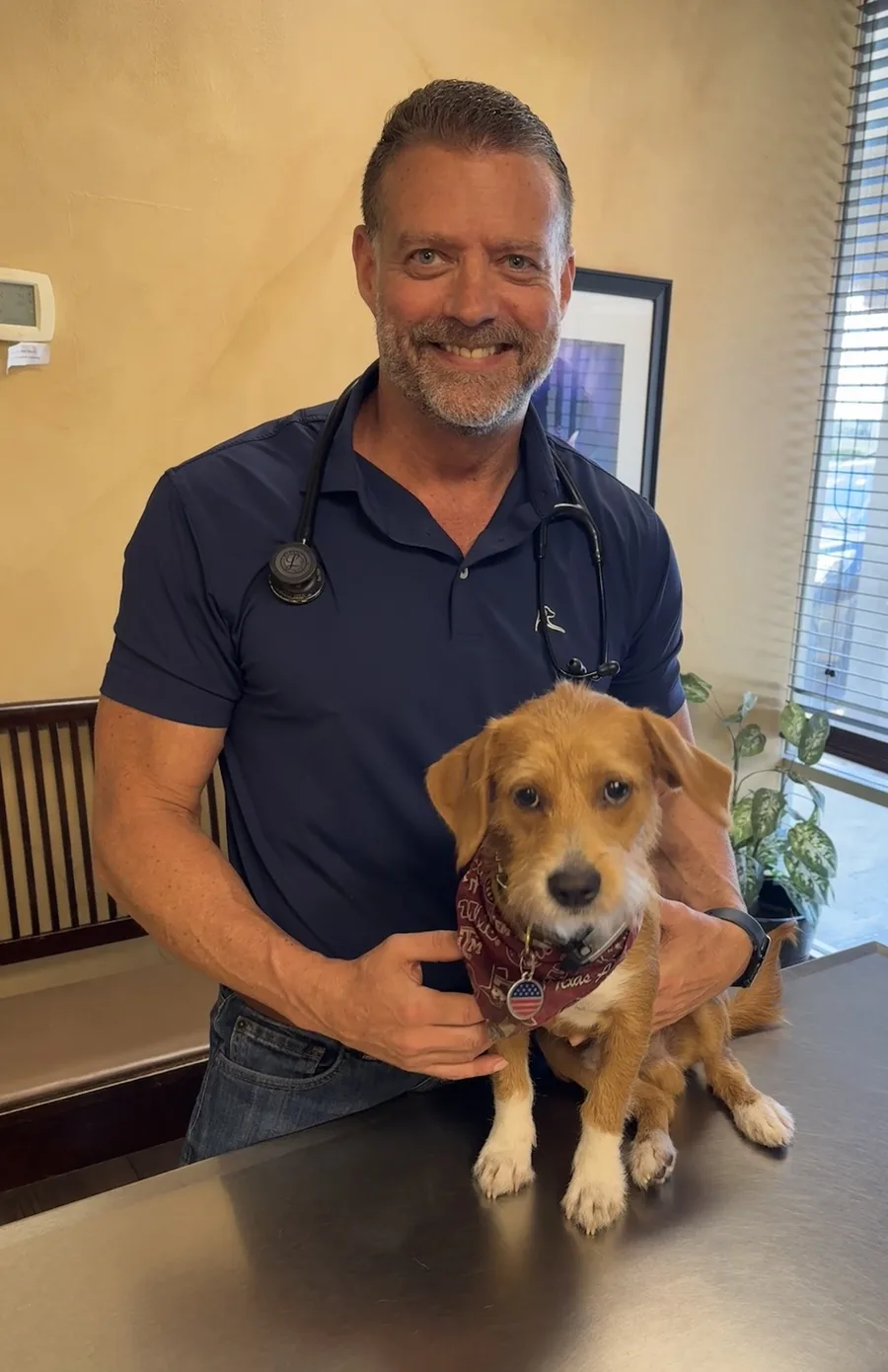
Dr. Steve Pelton, DVM
Hearthstone Animal Clinic, Cypress TX · since 1998
Last reviewed by Dr. Steve Pelton, DVM on
Jump to a sectionShowHide
If your dog has scratched, licked or chewed their way through another night, you've probably typed this exact question into your phone more than once. You're not overreacting. A dog that can't stop itching is uncomfortable, and so is everyone who lives with them.
Here's the short version I give in the exam room: it's almost always fleas, environmental allergies, food, or an infection riding on top of one of those. A lot of the time it's two of them at once.
Here's a bit more on each one, in the same order, easiest first.
1Fleas: the easy fix
A dog that's allergic to flea saliva doesn't need a big infestation to be miserable, and you may never see a single flea. Here on the Gulf Coast, fleas are a year-round problem, not a summer one.
That's why flea control is Step 0 on my list, before we talk about food or pollen at all. If your dog chews at their back end, the map below will tell you a lot.
2Food: it takes a diet trial
I get asked this every single day, and I get why. Food is the one thing you control completely, so it's the first thing you want to change. Sometimes you're right to.
The best summary we have is a 2017 review by Olivry and Mueller that pulled together studies from 1980 to 2016. Food reactions showed up in about 18% of itchy dogs, about 20% of dogs with allergic skin disease, and about 29% of dogs with atopic-type skin. Across all dogs seen by vets, it's only 1 to 2%.
That review has limits. It came out before the doodle and Frenchie boom, few of the studies put every dog through a real diet trial, and none looked at doodles specifically. In my own practice I've seen a big jump in food-allergic dogs since then, especially doodles reacting to chicken, and Frenchies. Chicken dominates kibble, treats and chews, and allergies follow exposure.
As for which foods: when Mueller, Olivry and Prélaud added up the published cases in 2016, beef led the list (34% of food-allergic dogs), then dairy (17%), chicken (15%) and wheat (13%). Lamb came in at only 5%. Those studies also came before the doodle boom, which is why chicken sits at the top of my own list today. And it's why I use a prescription food for the trial, not a "lamb and rice" bag from the pet store.

The only way to know for sure is the diet trial. Here's how mine works.
3Environment: managed, not cured
Pollen, mold and dust mites. Vets call this atopic dermatitis, and it runs in families. In Labs and Goldens, the heritability of atopic dermatitis is about 0.47, which is a scientist's way of saying genes do a lot of the work. In that study, when both parents were atopic, about 65% of their puppies were too.
Seasonal or year-round?
Itch that comes and goes with the seasons points toward pollen. Itch that never lets up points toward something that's always there, like food, dust mites or fleas.
Nobody has published a breakdown of itchy-dog causes for Texas. My educated guess is that our pollen, mold, humidity and year-round fleas push Houston dogs more toward environmental and flea allergies than the national numbers would suggest.
Because there's no cure, the goal is a comfortable dog, not a perfect one. We step up the treatment only as far as your dog needs, and back down when the season eases.
Where's the itch?
Where your dog scratches tells you a surprising amount. It's one of the first things I look at, and you can look at it tonight from the couch.
Where's the itch?
Tap where your dog scratches
Where a dog itches is one of the first things I look at. Tap every spot your dog licks, chews or scratches.

Tap a glowing spot on the dog, or pick from the list below. Tap as many as you like.
General education, not veterinary advice. If your dog is miserable, see your vet.
Rump, lower back and the base of the tail: think fleas first, even if you've never seen one.
Paws, ears, face, armpits, belly and groin: think allergies first, environmental or food. Those spots have more mast cells (the allergy cells), thinner skin, warm folds, and the most direct contact with the world. The ear canal is skin too, which is why so many allergic dogs keep getting ear infections.
Before you spend money
Three things I end up telling almost every owner, usually after they've already paid for the first one.
Don't waste money on this
Don't spend money on allergy test kits. The hair and saliva kits sold online are worthless: in two separate studies they reported "allergies" in samples of fake fur and plain water. No test, skin or blood, can tell you whether your dog has allergies, and none can diagnose food allergy. Testing is only for building allergy shots. For that, the gold standard I trust is intradermal skin testing by a board-certified veterinary dermatologist. The guidelines also accept blood tests for choosing what goes in the shots, but blood tests often come back positive in dogs that aren't allergic, and different labs don't agree well with each other.
Supplements and probiotics
Supplements and probiotics don't cure allergies. Some, like fish oil, may help support healthy skin alongside a real plan, but they shouldn't replace one.
When I send you to a dermatologist
For complicated dogs who aren't getting better, the next step is a board-certified veterinary dermatologist. A full workup there typically runs $2,000 to $5,000, and I'll tell you when I think it's worth it.
How allergies actually work
A few minutes on what's actually going on inside your dog's skin. It'll make the rest of this page click.
Why are allergies exploding?
If it feels like every other dog at the park is itchy now, you're not imagining it.
Skin allergies have been Nationwide pet insurance's number one dog claim for 13 years straight, and the yearly claim count went from about 335,000 in 2021 to about 450,000 in 2024.
Part of that is that we're noticing it more. More dogs are insured, owners take itch seriously now, and since Apoquel came out in 2013 there's finally something that works well, so more itchy dogs come in. But that's not the whole story.
Here's where the evidence points:
Your dog's itch probably started with genetics, got switched on by a too-clean modern life, and may have been nudged by early diet. Vaccines and today's kibble are probably not the villains.
Allergy-prone breeds like Frenchies, doodles, Labs, Goldens and the bully breeds have exploded since 2000, often from breeders who don't select against skin disease. And a Finnish study of 5,722 dogs found allergy symptoms were more common in city dogs, and less common in dogs from bigger families or with regular contact with farm animals and other pets.
The full story, with all the studies, is getting its own page soon.
Where to go from here
If your dog is miserable right now, start with what you can safely do tonight. If you're past that and wondering whether Apoquel, Cytopoint or steroids are right for your dog, here's my honest take on the itch meds.
Where this comes from
- Dr. Steve Pelton, DVM: client handout No. 04, Understanding and managing your dog's allergies (Hearthstone Animal Clinic, 2026).
- Hensel P, et al. 2015. Canine atopic dermatitis: detailed guidelines for diagnosis and allergen identification (ICADA). BMC Vet Res 11:196.
- Olivry T, et al. 2015. Treatment of canine atopic dermatitis: 2015 updated guidelines (ICADA). BMC Vet Res 11:210.
- Olivry T, Mueller RS. 2017. Systematic review of food adverse reactions in dogs and cats (studies from 1980 to 2016).
- Mueller RS, Olivry T, Prélaud P. 2016. Common food allergen sources in dogs and cats. BMC Vet Res 12:9.
- Coyner K, Schick A. 2019, and Bernstein JA, et al. 2019: hair and saliva allergy tests on fake samples.
- 2023 AAHA Management of Allergic Skin Diseases in Dogs and Cats Guidelines.
- Hakanen E, et al. 2018. Finnish study of 5,722 dogs on urban living, family size, animal contact and allergy symptoms.
- Shaw SC, et al. 2004. Estimation of heritability of atopic dermatitis in Labrador and Golden Retrievers. Am J Vet Res 65:1014-1020 (heritability about 0.47; about 65% of puppies atopic when both parents were, as cited in Hemida M, et al. 2020, PLOS ONE 15:e0225675).
- Nationwide pet insurance claims data, 2021 to 2024.
- Dr. Steve Pelton, DVM: clinical experience, Hearthstone Animal Clinic, Cypress TX.