



Is it the food, or is it the season?
Hearthstone Animal Clinic, Cypress TX · vet since 2000
How do I tell food from a seasonal pollen itch?
The itch flares up this fall, and you start eyeing the dog food bag. That's one of the most common questions I get in my Cypress exam room, and it makes sense. Food is the one thing you control, so it feels like the place to start.
The tricky part is that a food allergy and a pollen allergy look the same on the dog. Both itch the paws, ears, face, armpits, belly and groin. A large study of allergic dogs, published in Veterinary Dermatology, found the food dogs and the non-food dogs couldn't be told apart by their itchy spots.
So I don't look at where he itches to sort this out. I look at when.
What does the calendar tell me?
Itch that comes and goes with the seasons points toward pollen. Itch that never lets up points toward something that's always there, like food, dust mites or fleas. Food doesn't change with the weather, so a food allergy doesn't either.
Take two of our cartoon dogs. Biscuit is fine all summer and miserable every October. That's a pollen pattern. Tank scratches every week of the year, January included. That's an always-there pattern, and food goes on his list.
That same study found food-allergic dogs were less likely to flare with the seasons and more likely to have stomach or bowel trouble too, like vomiting or soft stool. Ears that flare all year are another clue I take seriously. Ears all year make me think food first.
Houston makes this harder. Something is usually blooming here, and mold is around all year, so a pollen dog can look almost year-round. The question I ask is whether he ever gets a real break. A dog who gets good weeks between the bad seasons leans pollen. A dog who never fully clears up leans toward something always there.
If the itch rises and falls with the seasons, the itch forecast shows what's in the air in your ZIP today, and you can watch whether his bad days line up with it.
How common are food allergies, really?
Less common than the pet food aisle would make you think. Food plays a role in roughly a fifth to a third of allergic dogs, and only about 1 to 2% of all dogs seen by vets, based on a review of the published studies.
So food is real, and it's worth ruling out in the right dog. It just isn't the answer for most itchy dogs. When it is food, the usual problem is a protein. In the studies, beef, dairy and chicken top the list.
Can it be both?
For sure. I think of itch like a bucket with several faucets running into it. Pollen is one faucet. Food can be another. Fleas are another. When the bucket overflows, you see the itch.
That's why a dog with a food allergy can still get worse in the fall. The food faucet runs all year, and ragweed opens a second one on top of it. If your dog has a low, steady itch all year with bigger flares in spring and fall, both could be in play.
Fleas come first no matter what the calendar says, because they're the cheapest to rule out. Itch on the rump, lower back and base of the tail points toward fleas. Prevention usually runs about $25 to $35 a month.
What do I do with what I see?
If the itch follows the seasons, the environment is the main fight, and that's managed rather than cured. If it never lets up, the next step after fleas is a food trial. Blood, hair and saliva tests don't reliably answer the food question. A strict trial does.
A food trial runs about 10 to 12 weeks on a prescription diet, and the whole thing usually costs about $250 to $750, most of that food he'd be eating anyway. The details are on the food trial page, and I'll walk through the timing in Monday's post. Don't switch foods on your own first. A bag from the store with a new protein on the front usually isn't strict enough to answer the question, and you'll have spent weeks without an answer.
The order of work is on my itch ladder, and the whole food section is on Why is my dog itchy?.
For the whole picture in one place, The Itchy Dog Quick Guide has it in pictures. Chapter 9 of The Itchy Dog is the full chapter on the food trial, and chapter 4 is the itch bucket. If you'd like a short note from me when the season turns, the itchydog.vet newsletter is free.
Sources
Favrot C, Steffan J, Seewald W, Picco F. A prospective study on the clinical features of chronic canine atopic dermatitis and its diagnosis. Veterinary Dermatology 2010;21(1):23-31.
Olivry T, Mueller RS. Critically appraised topic on adverse food reactions of companion animals (3): prevalence of cutaneous adverse food reactions in dogs and cats. BMC Veterinary Research 2017;13:51.
Hensel P, Santoro D, Favrot C, Hill P, Griffin C. Canine atopic dermatitis: detailed guidelines for diagnosis and allergen identification. BMC Veterinary Research 2015;11:196.
Questions owners ask
- How common are food allergies in dogs?
- Less common than the ads suggest. Food plays a role in roughly a fifth to a third of allergic dogs, and only about 1 to 2% of all dogs seen by vets.
- My dog's itch got worse this fall. Does that rule out food?
- No. A dog can have a food allergy and a pollen allergy at the same time. If he never fully clears up between the bad seasons, food is still worth ruling out.
- Can a blood test tell food from pollen?
- Not for food. The only reliable way to find out whether food is part of the itch is a strict food trial with your vet, about 10 to 12 weeks long.
More from the blog
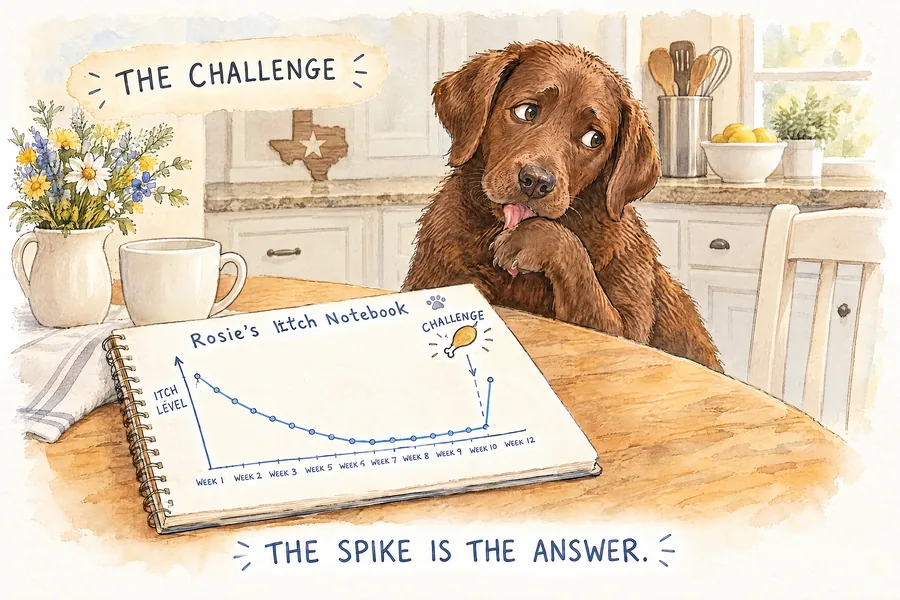 How long does a food trial actually take?A fair food trial for an itchy dog runs 10 to 12 weeks on a prescription diet, then about 2 weeks for the challenge. Why week three is too soon to judge.
 What is cedar season, and can it itch a dog?Ragweed is done, but cedar season starts in mid December. Here's what it is, how the pollen reaches Houston, and why an allergic dog can itch through it.
 Why did the itch medicine seem to stop working?Your dog was doing great on his itch medicine, and now he's scratching again. Most of the time the drug didn't quit. Something new got in on top.
Keep one handy
 The short versionThe Itchy Dog Quick GuideWhat to Watch, What to Do, and When to Call Your Vet, in Pictures
Want the whole story? The Itchy Dog is on Kindle too. The monthly note lives in the newsletter archive.
Monthly itch-season tips from Dr. Pelton
A short note from me when itch season ramps up, and what I'd tell you in the exam room that month.
I'll never sell your email. Read past issues