



Could this still be fleas if I never see one?
Hearthstone Animal Clinic, Cypress TX · vet since 2000
Could this still be fleas if I never see one?
This comes up in my Cypress exam room all the time. A dog is chewing at his back end, I bring up fleas, and the owner tells me, "But I've never seen a flea on him." I believe them. It still doesn't rule fleas out.
A flea-allergic dog is reacting to flea spit, so it only takes a few bites to keep him miserable. Those same dogs lick and chew so much that they tend to groom the fleas right off. The Merck Veterinary Manual notes that the most sensitive dogs are often almost free of fleas.
Take Biscuit, one of our cartoon dogs. She gets bitten on Sunday, has her tail base chewed pink by Wednesday, and nobody in her house has seen a flea all year.
Why can't I find the fleas?
Because the fleas on the dog are the tip of the iceberg. The adults on your pets are only a small slice of the fleas in your house, about 5% by the usual rough rule. The rest are eggs, larvae and cocoons, down in the carpet, the couch cushions, the cracks in the floor, and especially wherever the pets sleep.
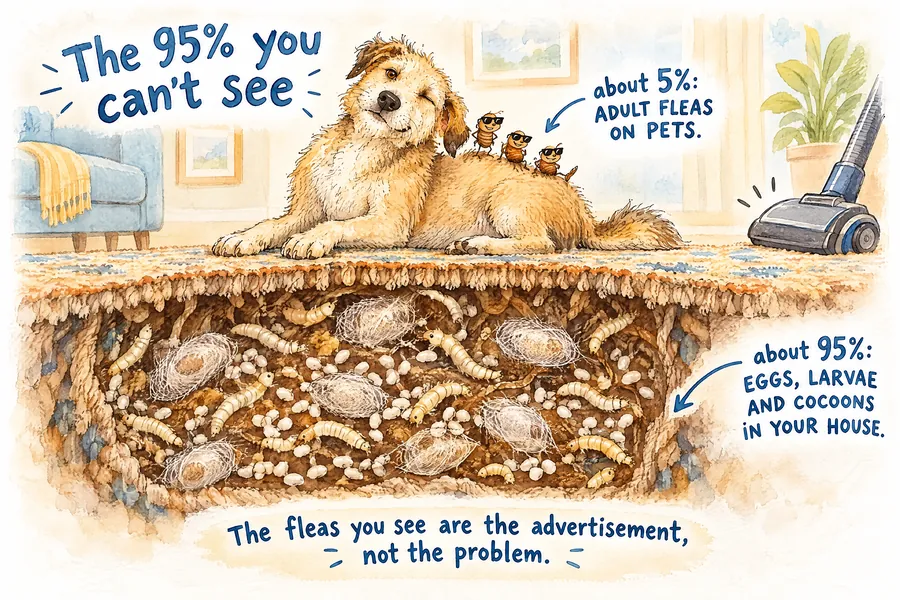
The cocoon is the tough stage. It shrugs off most sprays and waits for footsteps, warmth and the carbon dioxide you breathe out before the flea inside hatches. The veterinary dermatology guidelines note a flea can sit in that stage for up to 174 days.
And here on the Gulf Coast, fleas are a year-round problem, not a summer one. A mild Houston winter doesn't slow them down much.
Where does a flea-allergic dog itch?
The rump, the lower back, the base of the tail and the back of the thighs. That's the classic pattern veterinary dermatologists look for. If that's where your dog chews, I think fleas first, even if you've never seen one.
Paws, ears and face point more toward environmental or food allergies. But plenty of dogs have a flea allergy on top of one of those, and a dog with both can scratch just about everywhere. The Where's the itch? map shows what each spot usually means.
How do I rule fleas out for sure?
You run a flea trial. It's rung 1 on my itch ladder, because while fleas are still in the mix, nothing else will look like it's working. It's also usually the least expensive step on the whole ladder, a lot less than allergy medicine or a food trial, so it makes sense to settle it first.
- Every pet in the house, dogs and cats, each with a vet-recommended product made for its species and weight.
- On schedule, every time. That's monthly for most products, and some last 12 weeks. Follow the box, not "around the first of the month."
- Year-round. No winter break.
- For at least two to three months before you decide fleas weren't the problem.
The wait is the part people skip. Those cocoons are a waiting room. Treat the dog perfectly, and new adults keep hatching out of the carpet for weeks. That's not the medicine failing. It's the waiting room emptying. A good monthly product turns your dog into a flea trap: a new flea jumps on, takes a bite, and dies before it can lay eggs. Keep that up and the house runs out of fleas.

One untreated pet keeps the whole house in business. A treated dog and an untreated cat is a flea farm with a security guard at one door. And never put a dog flea product on a cat. Some of them can kill a cat. Ask your vet for the right product for each one.
When should I call my vet?
If he's still himself and the skin isn't raw, you can start the flea trial and watch. Call when the skin changes, or when he does. The full list is on Itchy tonight.
For the whole picture in one place, The Itchy Dog Quick Guide covers what to watch, what to do, and when to call your vet, in pictures. Chapter 6 of The Itchy Dog is the full flea chapter. If you'd like a short note from me when the season turns, the itchydog.vet newsletter is free.
Sources
Hensel P, Santoro D, Favrot C, Hill P, Griffin C. Canine atopic dermatitis: detailed guidelines for diagnosis and allergen identification. BMC Veterinary Research 2015;11:196.
Dryden MW. Fleas of Dogs. Merck Veterinary Manual, Dog Owners edition, revised 2024.
Questions owners ask
- Can my dog have a flea allergy if I've never seen a flea?
- Yes. A flea-allergic dog reacts to the flea's spit, so a few bites can keep him itchy, and all that licking and chewing tends to groom the fleas off. Not seeing one doesn't rule it out.
- Where do dogs with a flea allergy usually itch?
- The rump, lower back, base of the tail and the back of the thighs. Paws, ears and face point more toward environmental or food allergies, and plenty of dogs have fleas on top of one of those.
- How long before I know whether it was fleas?
- Give it at least two to three months of every pet in the house on a vet-recommended preventive, on schedule, before you decide fleas weren't the problem. New fleas keep hatching out of the carpet for weeks, and the skin needs time to heal.
- Do fleas go away in the winter around Houston?
- No. On the Gulf Coast fleas are a year-round problem, so flea prevention doesn't get a winter break.
More from the blog
 Why does my dog lick his paws after a walk?Paw licking after a walk is usually allergies. Why the feet go first, what a corn-chip smell means, what helps, and when to call your vet.
 Why is my dog itchier this fall?Around Cypress, fall itch is usually ragweed and mold. Here is the pattern, and when to call your vet.
Keep one handy
 The short versionThe Itchy Dog Quick GuideWhat to Watch, What to Do, and When to Call Your Vet, in Pictures
Want the whole story? The Itchy Dog is on Kindle too. The monthly note lives in the newsletter archive.
Monthly itch-season tips from Dr. Pelton
A short note from me when itch season ramps up, and what I'd tell you in the exam room that month.
I'll never sell your email. Read past issues