

How long does a food trial actually take?
Hearthstone Animal Clinic, Cypress TX · vet since 2000
In the food-or-season post I promised to walk through the timing. It's longer than most people expect, and knowing why is what keeps a good trial from getting thrown away.
How many weeks is a fair food trial?
Ten to twelve weeks on a prescription diet and nothing else. That's what I ask for in my Cypress exam room, and it's what the food trial page says.
The international guidelines for allergic dogs set the floor at 8 weeks: the diet should be fed exclusively for a minimum of 8 weeks. I add a few weeks on top of that so the slow dogs have time to show you what the diet can do.
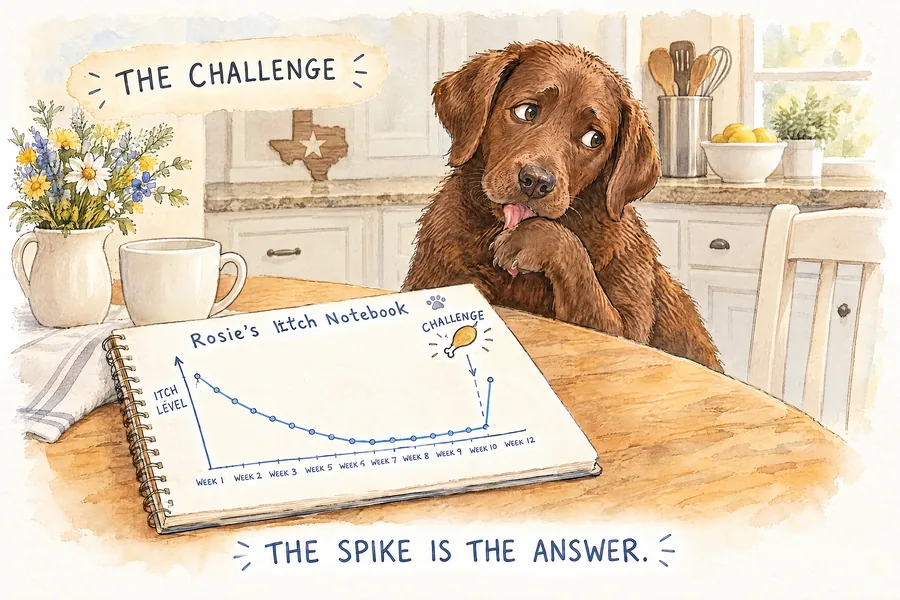
Then comes the part everyone wants to skip, the challenge, which takes about 2 more weeks. So from the first bowl to a real answer, plan on roughly three months.
Why can't I judge it at week three?
Because a lot of dogs look about the same at week three, and a lot of owners give up right there. Most of the action happens after the first month.
A review that pooled the published food trials in dogs found that after 3 weeks, only about half of the food-allergic dogs had improved a lot. By 5 weeks, more than 80% were better. Stretching to 8 weeks got that past 90%, and a few dogs took as long as 13 weeks.
So at week three, a big share of the dogs who are going to get better haven't yet. Quitting then throws the answer away.
What happens during those weeks?
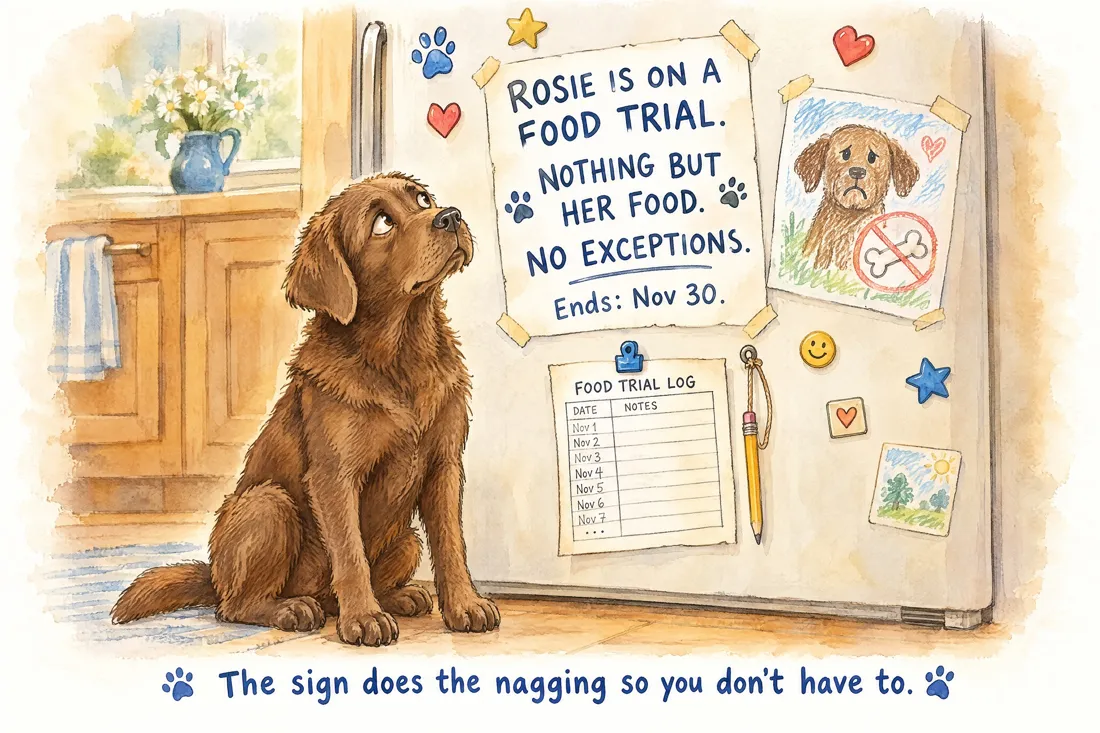
For the first month, it's the trial diet only. Score the itch every day or two and write it down, but don't judge it yet.
It's fine, and normal, to treat infections and control the itch at the start so he isn't miserable. Don't stop any itch medicine on your own. Your vet will plan when it comes off so you can read the result.
Why does the challenge add more time?
If he gets better, the trial isn't finished. A dog who improves during a trial might have improved for other reasons: the pollen season ended, the ear infection finally cleared, the weather cooled off. Going back to the old food is what proves it.
In a review of food challenges in dogs, half of the food-allergic dogs flared within 5 days of the old food going back in, and it took 14 days to catch more than 90% of them. So if he doesn't flare in 2 weeks, the improvement probably wasn't the food. If he does, the spike is the answer, and he goes back on the trial diet until he's calm again.
What makes a food trial take longer?
One cheat resets the clock. A food-allergic dog can flare within a day or two of eating the problem protein, and the skin then needs time to calm back down. It happens in the best homes. If it does, don't hide it, and don't beat yourself up. Write it in the notebook and call your vet.
The cheats are usually things nobody thinks of as food: flavored heartworm and flea chews, flavored toothpaste, pill pockets, the cat's bowl, and the kids' dropped crusts. Never stop heartworm or flea prevention during the trial, though. Decide with your vet before day one whether he stays on his usual chew or switches to a topical.
A bag from the pet store with a new protein on the front doesn't count either. It has to be prescription grade, or the trial doesn't count.
What does a food trial cost?
The whole thing usually runs about $250 to $750, and most of that is food he'd be eating anyway. The expensive trial is the one that stops at week three, because you've spent the money and still don't know.
Blood, hair and saliva tests won't save you the time. They don't reliably answer the food question. The trial does.
The full plan, including what he can have and the sneaky stuff, is on the food trial page. You can watch Rosie get through her 12 weeks in the food trial game. Chapter 9 of The Itchy Dog is the whole chapter on the food trial, and The Itchy Dog Quick Guide has it in pictures. If you'd like a short note from me when the season turns, the itchydog.vet newsletter is free.
Sources
Hensel P, Santoro D, Favrot C, Hill P, Griffin C. Canine atopic dermatitis: detailed guidelines for diagnosis and allergen identification. BMC Veterinary Research 2015;11:196.
Olivry T, Mueller RS, Prélaud P. Critically appraised topic on adverse food reactions of companion animals (1): duration of elimination diets. BMC Veterinary Research 2015;11:225.
Olivry T, Mueller RS. Critically appraised topic on adverse food reactions of companion animals (9): time to flare of cutaneous signs after a dietary challenge in dogs and cats with food allergies. BMC Veterinary Research 2020;16:158.
Questions owners ask
- Can I stop the food trial early if my dog looks better?
- Not on your own. Keep him on the diet until your vet has seen him. Your vet may move to the challenge once he's clearly better, and some partial improvements are easy to miss at home.
- Does one slip mean starting over?
- Not always. A food-allergic dog can flare within a day or two of the problem protein. Write it down and call your vet. It may only cost a week or two, and your vet will tell you whether to keep going or add time.
- What if my dog isn't better after 12 weeks?
- After a clean trial, that's still an answer. Food becomes very unlikely, and that points to atopy, the environmental allergy.
- Is there a test that skips the food trial?
- No. Blood, hair and saliva tests don't reliably answer the food question. A strict food trial is the only reliable way to find out.
More from the blog
 Is it the food, or is it the season?Food allergies and pollen allergies itch in the same spots. The calendar is the best clue you have. How to read it, and what to do next.
 Do those hair and saliva allergy kits work?Hair and saliva dog allergy kits look like a shortcut. They can't tell allergic from healthy, or real fur from fake. Spend that money on a real workup.
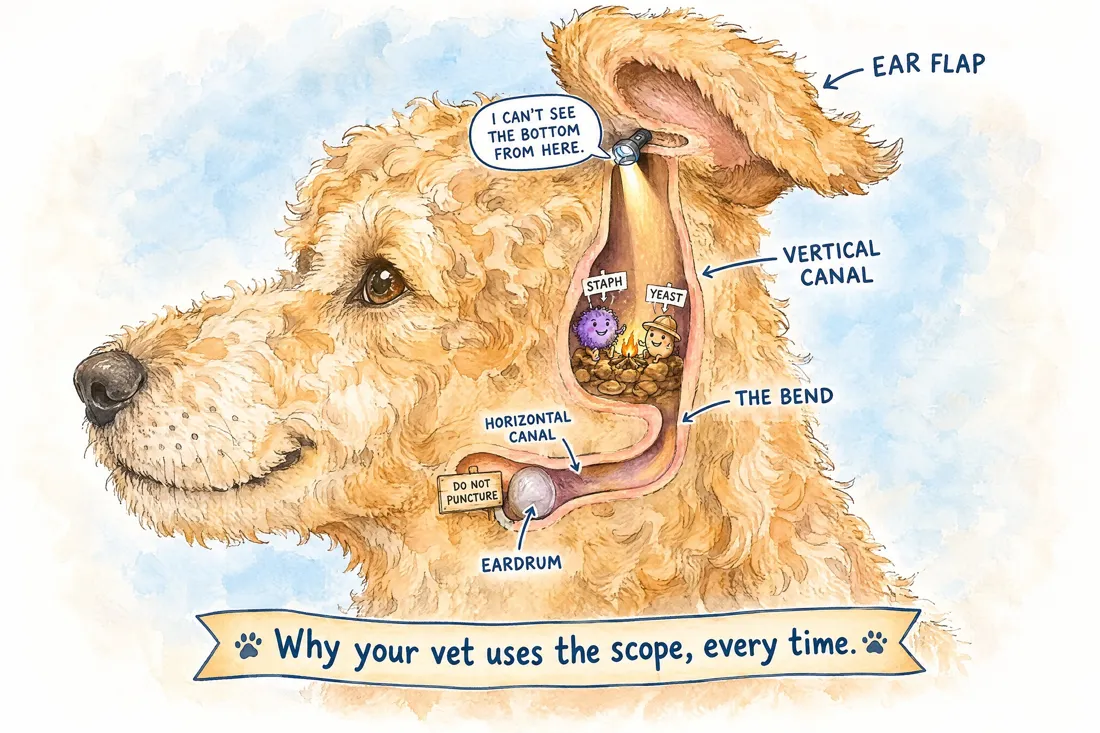 Why do my dog's ears keep getting infected?An ear infection that keeps coming back almost always has an allergy underneath it. Why ears trap trouble, what a bad ear looks like, and when to call.
Keep one handy
 The short versionThe Itchy Dog Quick GuideWhat to Watch, What to Do, and When to Call Your Vet, in Pictures
Want the whole story? The Itchy Dog is on Kindle too. The monthly note lives in the newsletter archive.
Monthly itch-season tips from Dr. Pelton
A short note from me when itch season ramps up, and what I'd tell you in the exam room that month.
I'll never sell your email. Read past issues